
Okay.
I know.
I’m hella late. 😅
But you know what?
This is a hobby.
And I told myself from the very beginning that I was not about to stress myself out over something that is supposed to bring me joy.
So I didn’t.
Also — let me go ahead and set expectations right now:
You will get a new post from me at least every month-ish.
Heavy on the -ish.
Because this past week, I was on the road — traveling with my family from my home in Jacksonville, Florida to my husband’s hometown of Detroit (which is also near where we went to college).
And it was worth every second.
I got to see family.
I got to see old friends.
And I got to watch my now eight-year-old get loved on and celebrate his birthday doing all his favorite things.
There was no way I was cutting that short to finish a blog post.
Absolutely not.
Now.
That being said…
For your patience?
I have gifted you a long post.
And when I say long…
Don’t look at the scroll bar on the side. It’s just going to stress you out. 😂
But let me tell you why this one is so long.
First of all, I read John Adams by David McCullough.
A Pulitzer Prize-winning, 652-page tome.

And you might be wondering — as several of my friends did — what all the different colored tabs mean.
Let me clear that up right now:
They don’t mean anything.
That just means I ran out of that color.
Y’all.
I had 50 post-its of each color.
So… yeah.
For a quick peek into my process:
I took notes directly in the margins and added post-its to mark sections — each tab corresponding to where that moment might fit in the blog.
Then I typed everything up.
Added notes from podcast episodes.
Layered in my commentary.
And started building the post from there.
My notes alone?
16 pages.

Sixteen.
Pages.
And all of that got narrowed down to the beautiful-ness you see before you.
So with that in mind:
Take your time.
Get a snack.
Grab a drink.
Take a break if you need to.
But if you take a break?
Come back and finish it.
Let’s get into it.
The Man: A Brief Bio
You don’t even have to remember, because it’s in the title — BRIEF.
Alright, so boom.
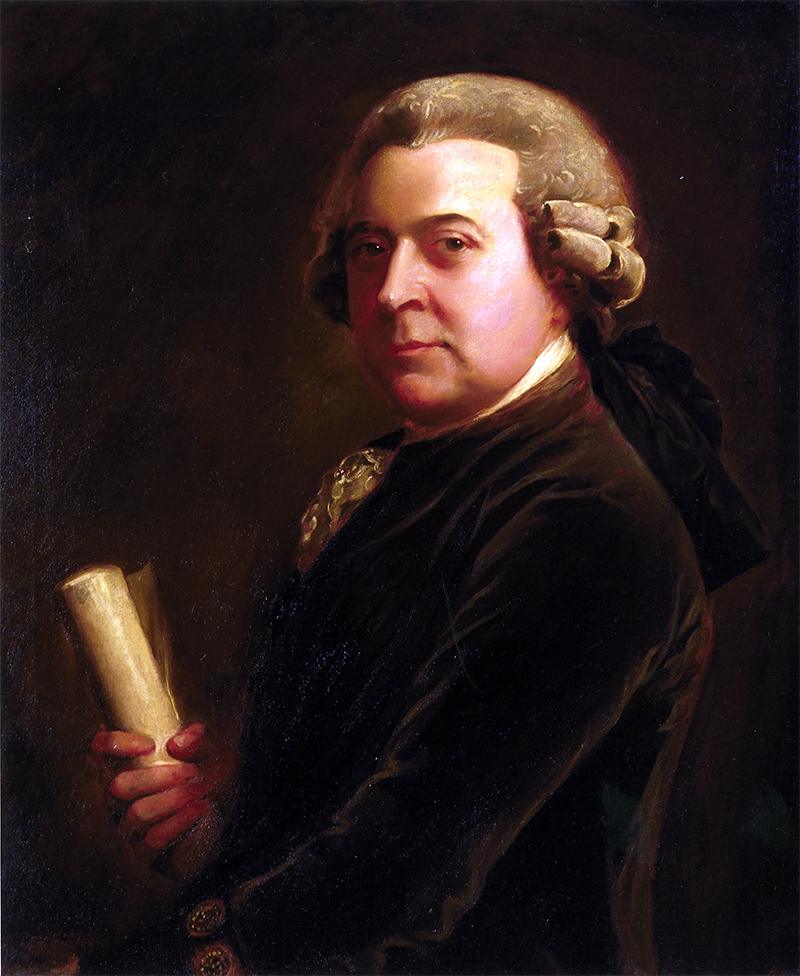
John Adams was born October 30, 1735, in Massachusetts — not into wealth or prestige, and definitely not with the type of background we would typically think of when using the phrase Founding Father.
But, what he did have was a sharp mind, a strong work ethic, and just enough stubbornness to carry him through just about anything.
Adams went to Harvard on scholarship, became a schoolteacher for a time, and then a lawyer — while also maintaining responsibilities on his family’s farm.1Unlike other Founding Fathers, when I say he was a farmer, I mean he actually worked on his farm, if you catch my drift. He would be described as a real New Englander: hardworking, frugal, independent, and deeply committed to doing things the “right” way.
When he was 25, his father died, making Adams the man of the house — a responsibility he took very seriously.

And then…there’s Adam’s personality.
Adams was a talker. Like, talker.
He loved people, loved conversation, loved a good drink, and a long debate. But he also had a tendency to say exactly what he thought — whether or not it was the right time, right tone, or the right audience. Even people who liked and admired him wished he would sometimes just…say less.
Thing was: he already knew this.
Adams was deeply self-aware. He once wrote that vanity was his “cardinal vice and cardinal folly.” And he admired people like Washington who could remain composed and reserved, while he himself struggled to do the same. He just couldn’t help himself.
He could be ornery, awkward, and overly sensitive — often convinced people were laughing at him (and sometimes they were). But he was also described as having a “heart formed for friendship” and was immensely likable on a personal level.
Basically: if you met him one-on-one, you probably liked him. If you read his letters…perhaps not so much.
He wasn’t physically imposing, didn’t have the effortless presence of someone like Washington, and never quite fit the image of a polished elite. But he was tough — physically and mentally — shaped by farm life and driven by a refusal to quit.
And he didn’t.
One of the earliest defining moments of his career came in 1770, when he agreed to defend the British soldiers involved in the Boston Massacre — despite enormous public pressure not to. No one wanted that case. Taking it meant risking his reputation, his career, and potentially his family’s safety. Not to mention, an L was pretty likely.
But Adams believed in the principle that everyone deserved a fair trial.
So he took the case.

In the end, six of the soldiers were acquitted. The other two were convicted of manslaughter, facing a branding on their thumb as opposed to the death penalty that would’ve been their fate.
Looking back, Adams would call it one of the most important acts of his life — not because it made him popular, but because it proved who he was.
He kept that same energy going into the Revolutionary era.
Adams was a driving force in the Continental Congress, pushing hard for independence. Tapping Washington as Commander-in-Chief of the Continental Army. Tapping Jefferson as primary author of the Declaration of Independence. And where Jefferson wrote and Benjamin Franklin observed, Adams argued.2I told you my guy was a talker. He was known as “the colossus on the floor” — the one who would stand up and say it with his chest.
But while Washington was becoming the visible war hero, Adams spent much of the Revolution abroad — negotiating, securing loans, and pushing for international support.
And he did a lot.
- He helped secure crucial funding from the Dutch.3NUMEROUS times! He and Jefferson once joked that when the time came for Adams to go to heaven, he would surely have to first negotiate another Dutch loan.
- He played a major role in negotiating peace with Britain.
- He traveled more than almost any other American leader of his time — over 29,000 miles — often under difficult and isolating conditions.
And he did it while being broke. Cuz, y’all, he stayed broke. And stayed mad about it. Because while it was easy for folks like Washington to espouse the view that public servants should not be paid, folks like Adams didn’t have the funds behind him to think in that same way. How was it that he was out representing the United States in Europe, expected to hobnob with the European elite, meanwhile living plainly and relying on his wife, Abigail, to hold down the farm at home alone??? Like, how does that work?

He was often frustrated. Often underappreciated. Often lonely — especially when separated from Abigail, who remained his emotional anchor throughout his life.
And yet, he never stopped.
Adams didn’t always get credit for what he accomplished. He didn’t always play well with others. He sometimes made things harder than they needed to be.
But he showed up.
Again and again.
And that — more than anything — is who John Adams was.
The Vice President
Oooo New Section, Who Dis?
Let me just start here:
John Adams was not built to be Vice President.
Like… at all.
When George Washington became President, it was widely assumed the Vice President should be a northerner, and Adams was the obvious choice. He had the reputation, the experience, the Revolutionary credentials.
What he did not have was the temperament for second place.
And everybody knew it.
Even at the time, people knew Adams was not the kind of man who sat quietly in someone else’s shadow. There were real concerns about whether he could quietly and loyally serve under someone else, especially someone like Washington, who commanded near-universal respect.
And then he lost the presidential vote to Washington… by a lot.
Washington received 69 electoral votes. Adams got 34.
That one hurt.

Adams was deeply sensitive to reputation, and this felt like a very public reminder of where he stood.
And then he stepped into the role.
And immediately realized… this job was not it.
Adams described the vice presidency as “not quite adapted to my character.” It was too inactive. Too mechanical. This was a man who loved to talk, debate, argue — and now his main job was to sit quietly and preside over the Senate.
And being quiet??? That alone was going to be a problem.
But to be fair to Adams — part of the issue was timing.
He had spent years abroad during the Revolution, and when he returned, American politics had changed. A new generation had taken hold — younger, sharp, ambitious men like Alexander Hamilton and James Madison — and Adams was stepping into a political environment that had moved on without him.
So here he is:
- deeply experienced
- extremely opinionated
- slightly out of step with the moment
- and in a role that required him to say next to nothing
It went about as good as you would imagine it went.
At first, Adams tried to engage as he normally would. He spoke in the Senate more than people thought appropriate. He had opinions — especially about things like titles,4Go back and read my Washington post for more on that. where he believed the presidency needed more formality and dignity to be taken seriously on the world stage.
Which, to be fair, is not a wild idea.
But in practice?
It made him look like he was doing the most.
And because no one was about to criticize Washington, Adams became the easier target. He got mocked. A lot. The title debate turned into a running joke, and Adams — after everything he had done for the country — found himself as the punchline.

That did not sit well with him.
Over time, though, something shifted.
Adams adjusted.
By the end of Washington’s presidency, he had learned to stay in his lane. He spoke less. He interfered less. He accepted the limitations of the role — even if he didn’t like them.
And despite everything, he was good at it.
He served longer as Vice President than in any other role in his career. He was loyal to Washington. He did the job as it existed — not as he wished it to be.
And he used the one real power he had: breaking ties in the Senate.
Adams cast 31 tie-breaking votes — more than any vice president in history — often on issues that helped define the authority of the new federal government.
So while the role frustrated him, he still shaped it.
But let’s let him tell it.
By his second term, Adams described the vice presidency as:
“the most insignificant office that ever the invention of man contrived or his imagination conceived.”
After everything we just talked about… he might not have been wrong.
The President
If Washington’s presidency was about creating the role, Adams’s was about figuring out what happens when things get messy.
Because by the time Adams took office in 1797, the country had already changed.
This was no longer a Kumbaya “we just fought a war together” moment. Political parties had formed. Lines had been drawn. And for the first time, the President and Vice President were from opposing parties.
So we’re already off to a GREAT start.
Adams won the presidency by a margin of just three electoral votes over Thomas Jefferson — 71 to 68.
Three.

This was the first truly contested, partisan election in U.S. history, and it was nasty. And the nastiness didn’t stop once the election ended.
Because now Adams had to govern.
And one of his first major decisions?
Keeping Washington’s cabinet.
I mean, on paper, it made sense. There was no tradition yet of replacing a previous president’s cabinet, and Adams wanted unity — especially within the Federalist Party. AND it wasn’t like Washington’s cabinet members were itching to resign.
In practice, though?
Terrible idea.
Because this wasn’t just Washington’s cabinet. It was a cabinet deeply aligned with Alexander Hamilton — including what were known as High Federalists, who were aggressively pro-British, anti-French, and very comfortable undermining their own President if it meant advancing their agenda.
So Adams walks into office already dealing with:
- a divided country
- an opposing party as his Vice President
- and a cabinet that is not really his
Again, you can see where this is going.
France, But Make It Complicated
Foreign policy dominated Adams’s presidency, specifically relations with France.
French forces were seizing American ships in the Caribbean. Talks with France weren’t working.5In no small part because the monarchy the U.S. had allied with during the Revolutionary War no longer existed. The king had quite literally lost his head. War felt just around the corner.
And Adams?
Did something that would define his presidency.
He tried to avoid that war.
Now — to be clear — Adams wasn’t passive. He was very much a both/and kind of man. He called for an increase in American naval forces while also continuing to pursue peaceful talks. His goals were clear:
maintain neutrality • defend national honor • avoid war
But also… don’t get caught slippin’.
Simple in theory.
Extremely not simple in practice.
Because while Adams was trying to balance both, his own party — especially the Hamilton-aligned faction — was leaning toward war.

Hamilton, in particular, had much bigger ambitions. There were even discussions of expanding conflict into Spanish territories. Empire-building energy.6Abigail Adams would refer to Hamilton as a second Napoleon.
Adams was not here for that.
So now the tension isn’t just:
America vs France
It’s:
Adams vs his own administration.
The Cabinet Problem (aka Hamilton, Again)
Let’s revisit that cabinet decision.
Because it comes back to bite him hard.
At one point, both the Secretary of State and Secretary of War were essentially feeding information to Hamilton and undermining Adams behind the scenes.
Hamilton — who was not the President — was operating like he might as well be.
At the same time, Washington was brought back in a symbolic military role, and Hamilton, as his “right-hand man” positioned himself to effectively control the army.
So Adams is sitting there like…
Am I running this government or nah?
Eventually, Adams had had enough.
He finally started firing people.
But by then, the damage was done. His own administration had already weakened him, and his relationship with the Federalist Party was… not great.
The Decision That Defined Him
But I’mma double tap on this, because it’s the part that matters most:
Adams chose peace.
Despite pressure.
Despite political risk.
Despite how it would look.
In 1799, he pushed forward with a new peace mission to France — even when many in his own party opposed it.
And it worked.
The Quasi-War ended. Conflict was avoided. The United States stayed out of a much larger war.
Now, any reasonable person would call that a major win.
And it cost him the presidency.
Because while Adams was out here preventing war, his party fractured, his support collapsed, and Hamilton actively worked against him (again).
The Alien & Sedition Acts
SIGH.
Okay. Stay with me. I promise this matters.
We need to talk about the Alien and Sedition Acts.
Because this is the part of his presidency that does not age well.
In 1798, Congress passed a series of laws aimed at immigrants and political dissent. Adams didn’t ask for them — but he also didn’t stop them. He signed them.
And the Sedition Act in particular?
It made it a crime to criticize the government.
Not plotting a takeover. Not starting a rebellion.
Criticize.
Anything considered “false, scandalous, and malicious” against the President or Congress could get you fined or thrown in jail.
Which is… a problem.
Especially for a country that had just fought a whole war over rights and representation.
Now, to be fair, context matters. This was a tense moment. There were fears about foreign influence, internal instability, and whether the country could hold itself together.
But still. This was a massive overreach.
And, of course, it backfired.
Badly.
Because now Adams’s critics had the easiest play in the book:
Say something critical → get arrested → prove your point.
People were literally getting jailed for criticizing the President, which made Adams look exactly like the kind of leader Americans had just fought to get away from.
One journalist called him:
- a “repulsive pedant”
- a “gross hypocrite”
- and “a hideous hermaphroditical character”

He was arrested, tried, and jailed.
And instead of silencing the opposition, it made them louder.
Now Adams doesn’t just have critics.
He has martyrs.
And politically? That’s a losing situation.
The Election of 1800
So by the time Adams ran for reelection, things were fully off the rails.
He was being attacked from all sides — Republicans, High Federalists, and Hamilton personally. All at the same time.
And for the first (and only) time in U.S. history, the sitting President was running against his own Vice President.
Despite everything, and contrary to popular belief, Adams didn’t do that bad — he lost 73 to 65.
But… he did lose.
And when he did, he didn’t fight it.
He didn’t challenge the results. 👀
He didn’t try to hold onto power.
He didn’t create chaos.
He packed his stuff and left. Quietly.
And after everything we’ve talked about — the division, the attacks, the pressure — that matters more than it might seem.
The Man in the Role
Adams never really saw the presidency as a crowning achievement.
To him, it was just the next responsibility.
And not even an enjoyable one.
He described the work as “very dry,” “dull,” “perplexing,” and “incessant.”
And honestly? I can understand why he felt that way.
During his presidency, he would spend long stretches back home in Massachusetts — partly because of recurring yellow fever outbreaks in Philadelphia, and partly because he believed he could do his job just as well from there.
Some people thought it hurt his reputation.
Adams didn’t seem especially pressed about that.
At one point, he wrote:
“My administration will not certainly be easy to myself. It will be happy, however, if it is honorable. The prosperity of it to the country will depend upon Heaven, and very little on anything in my power.”
And that’s really the throughline of his presidency.
Not ease.
Not popularity.
Honor.
And an understanding — whether people agreed with him or not — that there were limits to what he could control.
On Relationships
If Washington was defined by restraint, Adams was defined by connection.
This man needed people. Needed conversation. Needed to be in dialogue — whether that was debate, argument, or deep affection.
And two relationships, more than any others, shaped his life:
Abigail.
And Jefferson.
Abigail
Let’s start with the love of his life.
Because John Adams without Abigail Adams?
Is not the same man.
He called her his “dearest friend,” his “best, dearest, worthiest, wisest friend in the world.” And she, in turn, called him her “good man” and the “tenderest of husbands.”
They weren’t just married. They were partners.
Real partners.
Abigail was not sitting on the sidelines. She was reading newspapers, tracking political players, forming her own opinions, and writing to Adams constantly — advising, challenging, encouraging.
People noticed.
It wasn’t uncommon to hear that Abigail had real political influence, with one observer saying she was “as complete a politician as any lady in the old French Court.”7Honestly, she gives me Hillary Clinton vibes.
And Adams trusted her. Deeply.
More than his cabinet. More than his colleagues. More than most anyone.
That doesn’t mean he always agreed with her — he didn’t. But her voice mattered in a way that was unusual for the time.
And beyond the politics, there was just… love.
At one point, when Abigail reminded him he was sixty, Adams responded:
“If I were near I would soon convince you that I am not above forty.”
Still flirting after decades of marriage.
We love to see it.
But their relationship also says something bigger about Adams.
He wasn’t doing this alone.
He never was.
Jefferson
Now, this one? Is quite complicated.
Because John Adams and Thomas Jefferson are one of the most fascinating relationship arcs in American history.
They started as allies.
In the Revolutionary era, they worked closely together, spent time abroad, and genuinely liked each other. Adams even helped look after Jefferson’s child while they were overseas.
At one point, Jefferson wrote that Adams — with all his faults — had “won his heart.”8Still a bit shady, but that’s Jefferson’s way.
And then… politics happened.
By the time Adams was VP and Jefferson was Secretary of State, things had shifted. They stopped really talking about their differences. Jefferson kept things polite on the surface, but distanced himself behind the scenes — rarely seeking Adams’s input, even when it might have been useful.
And Adams?
He was no dummy. He felt it.
There were moments where Adams defended Jefferson publicly, while Jefferson… didn’t exactly return the favor. At one point, Jefferson compared him to a poisonous weed.
Which feels a little extra, but okay.
And then things escalated.
By the time Adams became President, Jefferson was Vice President from the opposing party, and his home became a gathering place for political opposition.
So now this isn’t just tension. It’s rivalry.
But not a clean one.
They were never fully out of each other’s orbit. They remained socially cordial at times, even as politically they moved further apart.
And then, years later, after all of it — the disagreements, the election, the distance — Adams reached out.9I highly doubt Jefferson would’ve been the first to do so.
New Year’s Day. 1812.
And just like that, they started writing again.
What followed was one of the most remarkable correspondences in American history.
They didn’t relitigate everything. Jefferson, especially, avoided digging back into old conflicts. But they talked about life. Aging. The country. Their shared past.
And Adams, in true Adams fashion, made peace with it all.
He wrote:
“I do not believe Mr. Jefferson ever hated me… he wished to be President… and I stood in his way… so he did everything he could to pull me down… but if I should quarrel with him for that, I might quarrel with every man I have had anything to do with in life… This is human nature… I forgive all my enemies…”
That level of clarity?
That level of acceptance?

They both lived long enough to see the country they helped build continue on without them.
And in one of history’s more poetic moments, they died on the same day — July 4, 1826. The 50th anniversary of independence.
Adams’s last words are said to have been:
“Thomas Jefferson still survives.”
He didn’t.
Jefferson had died hours earlier.
On Slavery
John Adams never owned enslaved people.
I’m going to say that again for the people in the back — because for some reason, this is not widely known.
🗣 John Adams, a Founding Father, never owned enslaved people.
Not because he couldn’t.
Because he didn’t believe in it.
And he said that. Out loud. In writing.
“I wish most sincerely there was not a slave in the province… [to] fight ourselves for what we are daily robbing and plundering from those who have as good a right to freedom as we have.”
He called slavery a “foul contagion in the human character” and an “evil of colossal magnitude.”
He never purchased enslaved people.
He never even hired the enslaved people of others to work for him.
And in a time when that was normal — expected, even — that matters.
But, of course, that can’t be the whole story.
Because Adams, like many of his contemporaries, was willing to set the issue aside politically.
When it came time to declare independence, neither he nor the other delegates were about to let slavery derail the moment. The contradiction was right there.
And trust. Those chickens will come home to roost.
It’s also important to remember: this wasn’t just a clean North vs. South divide.
New England — Adams’s home — had deep ties to the slave trade. At one point, a significant portion of its shipping economy depended on it.
So Adams’s stance wasn’t just regional. It was personal.
And even within his own household, the discomfort with slavery was visible.
Abigail Adams, especially, was vocal. While living in the South, she wrote about how disturbing it was to see enslaved people working while their owners stood idle. She criticized both the cruelty of the system and the culture surrounding it.
Still, neither of them turned that opposition into sustained political action.
But there were moments where Adams’s beliefs showed up in more tangible ways.
During his presidency, he supported Toussaint Louverture and the Haitian Revolution — a successful uprising led by formerly enslaved people.
And not quietly.
The United States provided:
- military support, including naval ships like the USS Constitution
- trade and supplies to sustain the revolution
- and diplomatic coordination through a U.S. representative on the ground
At one point, a representative of Louverture even dined with Adams — the first known instance of a man of African descent being formally received by a sitting U.S. president.
I’m sure I don’t have to explain to you how much that mattered. Symbolically and politically.10Not to mention, it was a big middle finger to the French.
Especially at a time when much of the world was trying to isolate what was happening in Haiti.
But even with all of that…
Adams still stopped short of pushing for full abolition at the national level.
He saw the problem clearly.
He spoke on it.
He lived differently than many of his peers.
And still — like so many others — he chose not to force the issue when it mattered most politically.
So where does that leave us?
Adams did not participate in slavery the way many of his peers did.
He spoke against it.
He avoided it in his personal life.
And at the same time, he accepted a political reality where it continued.
Which means, like so much of early American history…
we’re left sitting in the in-between.
The Legacy
John Adams feels… overlooked.
And I don’t love that.
Because when you really sit with it — when you read him, not just about him — you realize how much of this country he helped shape.
Not just through what he did.
But through how he thought.
Adams was one of the sharpest minds of his time.
An elite legal thinker. A prolific writer. Someone with a command of language that makes you stop, reread, and then just sit there like…
Because he wasn’t just reacting to the moment.
He was thinking long-term. Structurally. Systemically.
He understood people.
And more importantly — he didn’t trust people.
Not blindly, anyway.
He believed human beings were capable of great good… and great harm. That inequality would always exist in some form. That power would always concentrate if left unchecked.
And instead of pretending otherwise, he asked:
What kind of government accounts for that?
At one point, he wrote:
“You are afraid of the one, I, the few.”
Meaning — while others feared a single powerful ruler, Adams was more concerned about small groups of powerful people quietly taking control.
That still feels relevant.
He believed in what he called a “natural aristocracy” — people with talent, wealth, influence — but he didn’t trust them with unchecked power. He argued they needed to be balanced, contained, structured within government so they couldn’t dominate it.
He wasn’t chasing some perfect version of equality.
He was trying to design something that could survive reality.
And beyond the theory?
He built things.
Adams drafted the Constitution of Massachusetts — which is still the oldest functioning written constitution in the world.
👏🏾Still 👏🏾 Functioning 👏🏾 Today
And when it came time to lead?
He made decisions that cost him.
He built up the Navy.
He resisted pressure toward war.
He dismantled the beginnings of what could have become a standing military force under Hamilton.
And at a moment when war would have been popular — politically advantageous, even — he chose peace.
At the risk of his presidency.
At the risk of his reputation.
And he knew it.
And that was the decision he remained most proud of for the rest of his life.
Yet and still.
He doesn’t loom the way Washington does.
No massive memorial in D.C.11Or memorial of any type.
No constant cultural presence.
No universal “founding father hero” narrative.
Part of that is personality.
Adams wasn’t easy. He didn’t play the game well. He didn’t build coalitions the way others did. He didn’t always make himself likable in the ways that get you remembered.
And part of it?
Is that he didn’t have a political machine or legacy group pushing his story forward after he was gone.
He even worried about it.
He wondered how history would remember him. Whether his contributions would be minimized. Whether he’d be misunderstood.
And in a way…
He wasn’t wrong.

But here’s the thing.
Adams never walked away from what needed to be done.
He never stopped speaking when it mattered — even when it would have been easier to stay quiet.
He didn’t always get it right.
But he showed up.
Over and over again.
And if you read his letters — really read them — you see it.
The foresight.
The clarity.
The honesty.
At one point, he wrote:
“Public business, my son, must always be done by somebody… If wise men decline it, others will not; if honest men refuse it, others will not.”
And ain’t that the truth.
Adams may not be the most celebrated Founding Father.
He may not be the most beloved.
But he might be one of the most necessary.
Random, Interesting Facts
Even though this post is mad long, I had to keep this section. That part about Washington’s teeth in my last post still haunts my Mom. 😂
First: the family ties.
John Adams and Samuel Adams?
Second cousins.
And in case you didn’t know — turns out Samuel Adams was also a whole Revolutionary figure. I just knew the name from the beer. 🤷🏾♀️
Second: the birthday confusion.
Adams was born on October 19, 1735…
Except not really.
When Britain switched from the Old Style to the Gregorian calendar, his birthday became October 30.
So technically?
Same man. Two birthdays.
Third: this man was lowkey a novelist.
The way Adams described people had me cackling.
He once described someone as a:
“squaddy, masculine creature” with “a great, staring, rolling eye”… and “a rare collection of disagreeable qualities.”
And another man?
“His teeth black and foul and craggy… his eyes a little squinted… when he walks, he heaves away… when he speaks, he cocks and rolls his eyes…”
A bit of Charles Dickens energy.
Fourth: the bars.
And I mean STRAIGHT. BARS.
The number of times I wrote “BARS!!!” in my notes while reading this man…
I’m actually glad I owned this biography because the way I would’ve been marking up these library people’s book…
At one point, he asked:
“How few of the human race have ever had an opportunity of choosing a system of government for themselves and their children?”
He understood the moment.
He understood the legacy he was creating.
Fifth: Abigail had OPTIONS.
While Adams was away in France, one of his colleagues tried to shoot his shot.
And not subtly.
He called her “Portia” (Adams’s nickname for her), flirted heavily, and basically said “if you were mine…”
Excuse you, Sir???
Abigail shut it down — politely, but firmly.
But my girl also had wit, because she signed her reply:
“Portia.”
Sixth: Congress has always been… Congress.
In 1798, things got so heated in Congress that one representative spat in another man’s face. SPAT!
The other man came back swinging with a cane. The first grabbed fireplace tongs.
And the two of them started fighting on the House floor.
Kicking. Rolling. The whole thing.
Here’s what I imagine that looked like.
So when people say politics has gotten messy?
Just know…
It’s been messy.
The Rankings
Alright, let’s do this.
Quick refresher on how I’m thinking about these rankings:
- Fave Ranking: Who I personally like. Who I’d want to sit down with, read, argue with, or just observe in real time.
- Presidential Ranking: how well they actually did the job they were elected to do.
- Impact Ranking: how much they shaped the country long-term, whether for better or worse.
Fave Ranking: HIGH.
I’m not even going to pretend to be neutral here.
I really like John Adams.
Not least of all because I see so much of myself in him.
He’s nerdy. He reads constantly. He writes like somebody who cannot help but think deeply about everything. He feels things strongly. He overthinks. He knows he overthinks.
At one point, he wrote:
“I can as easily still the fierce tempests or stop the rapid thunderbolt, as command the motions and operations of my mind.”
That’s not a Founding Father.
That’s me on a random Tuesday.
He worried about not being original enough… while also being very aware that he might actually be too much — too opinionated, too outspoken, too ready to show people he was right.
And then this:
“Thanks to God that he gave me stubbornness when I know I am right.”
Yeah.
Adams is going to rank very high for me. I already know that.
Top 10? Easily.
Probably higher.
Presidential Ranking
Now — as a president?
He’s good.
But he’s no Washington.
And that’s not really a fair comparison, because Washington was out here holding the entire country together with vibes and precedent.
Adams inherited something already fragile and walked into a political mess.
And to be honest, I don’t even think the role was what he expected it to be.
It feels like they wanted a figurehead.
And Adams?
Is not a figurehead.
He pushed back. He made independent decisions. He refused to just go along with his party — which, to his credit, is part of why we avoided war.
But it also meant he didn’t fully play the political game.
And that cost him.
So while I respect his presidency — especially his decision to choose peace when war would’ve been easier politically —
He’s still coming in below Washington here.
Impact Ranking
Impact-wise?
He’s sitting right behind Washington.
And honestly, that feels right.
He didn’t create the presidency — but he helped define what it looks like when things get complicated.
- First truly contested election
- First president from a different party than his predecessor
- First to deal with real partisan division
- First to peacefully transfer power after losing
That last one is huge.
And it doesn’t get talked about enough.
But overall, I do think his impact will end up lower on my list over time, as we get into presidents who reshape the country more dramatically.
Which is… frustrating.
Because Adams mattered.
A lot.
And that’s kind of the story of John Adams.
Brilliant.
Principled.
A little difficult.
Deeply human.
Not always fully appreciated.
And somehow, still essential to the whole American experiment working at all.
Next up, the American Sphinx, Thomas Jefferson.
Leave a Reply