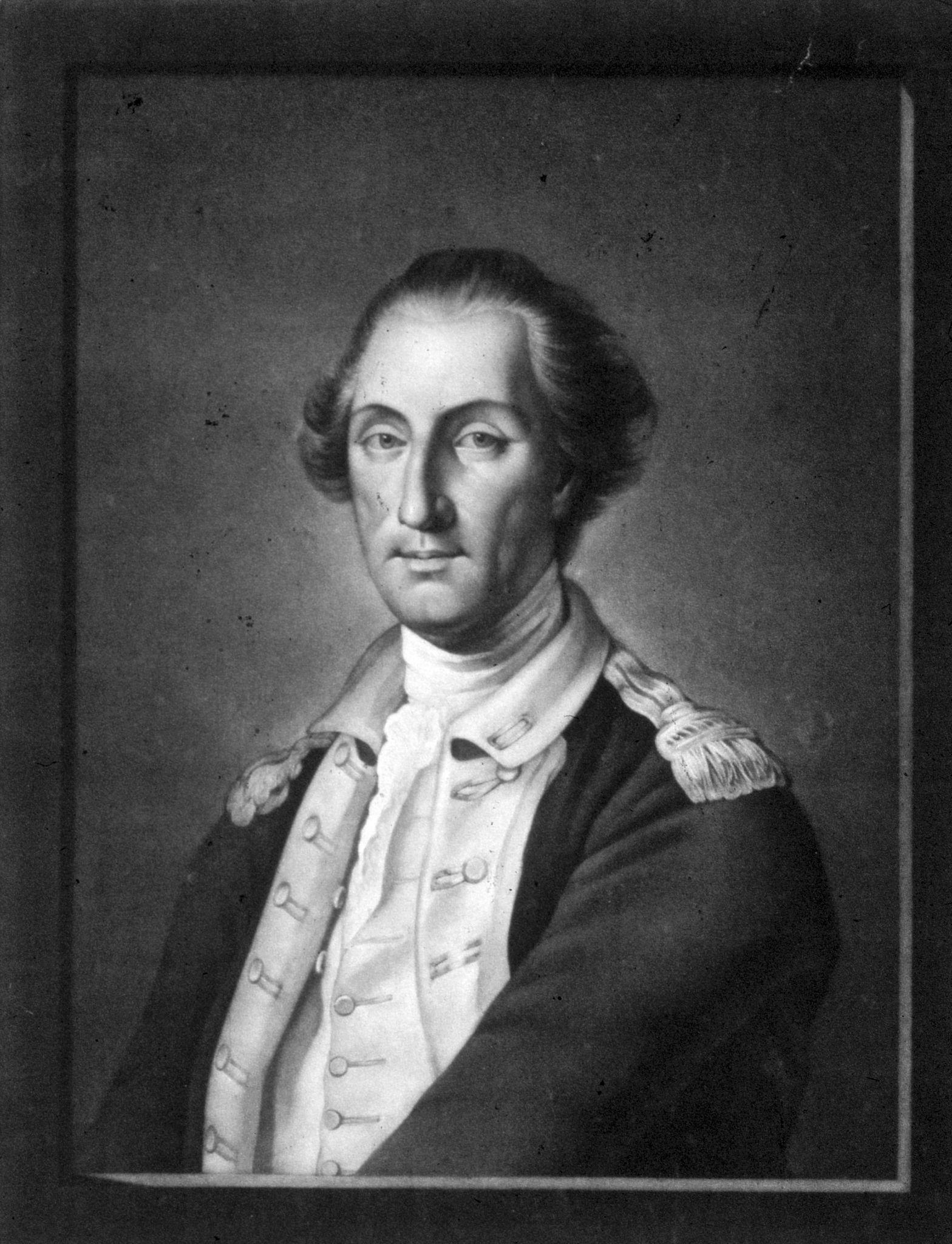
Okay, before we start: yes, I know!
This post is late.
As I very confidently said in my first post, I knew life would be lifeing and things might get off schedule. What I did not expect was for that to happen on the very first real post. LMAO.
There was a moment last night around 11pm where I was sitting on my laptop, STRESSED, only two sections written, questioning every life decision that had led me to this point.
And then I had to remind myself (read: my husband had to remind me) that the people who want to read this — my friends, my family, and whoever else ends up here — will read it whether it goes up late on the last day of the month, or late on the first day of the next month.
And/but more importantly: this project is supposed to be fun.
So I closed the laptop, took myself to bed, and finished it tonight. And honestly? I’m proud of myself for giving myself that grace. It’s something I need to do more often.
And so now I give you — George Washington.


I chose these portraits on purpose. Both were painted by Charles Willson Peale, and neither is the version we usually see. We’re used to Old Man Washington — powdered hair, stiff posture, currency energy. But before he was a symbol, he was a young Virginia Regiment officer trying to prove himself. A tall, ambitious 20-something with something to prove, not a marble monument.
I wanted to start there: not with the myth, but with the man.
How I approached this post
For each president I’m reading one biography and listening to podcast episodes, then pulling together what stood out to me — not a full historical retelling, but what helped me understand the person and the impact.
For Washington, I read You Never Forget Your First by Alexis Coe, which (one of the reasons I chose it) doesn’t treat him like a statue, has some really interesting tables laced throughout, and doesn’t shy away from the ever-present enslaved people around him who made his life possible.
I also listened to not two but three podcast episodes — because I forgot that American Elections: Wicked Game covers elections, not presidents, and Washington had two of them. So honestly, you’re welcome. I did more homework than expected.
My goal here isn’t to recreate a biography you can find just about anywhere. I want to understand who he actually was, how he made decisions, and why those decisions still echo today.
So let’s start with the man himself.
The Man: A Brief Bio
And I DO mean brief. My goal here is not to regurgitate every detail of these presidents’ lives.

Instead, I want to give an overview of who they were at the start and highlight the moments that shaped who they became.
George Washington was born February 22, 1732, at Pope’s Creek in Virginia, which, at the time, was part of British America.1“British America.” Don’t that sound weird?! He died December 14, 1799, at Mount Vernon at 67 after serving two presidential terms from April 30, 1789, to March 4, 1797. He is also the only president who was never formally affiliated with a political party.
Washington did not grow up poor, but also wasn’t part of the top tier of the Virginia planter elite. His father died when he was eleven, which meant he never received the classical education elite planters’ sons typically had. And that mattered to Washington.

For the rest of his life, Washington was hyper-aware of the fact that he lacked the education and polish of the gentry around him. He spent years teaching himself the etiquette and manners of a proper “gentleman.”
His first real career was as a surveyor. As a teenager, he traveled the frontier mapping land.2The “wilderness,” according to Europeans. “Home,” according to Indigenous people. It was not light work, but it provided Washington with independence and economic mobility. By his early twenties, he was getting money, getting land, and building status.
At this time, he had also entered into that Peculiar Institution. By way of inheritance from his father, and later through marriage, Washington had become an enslaver.3More on this later. At twenty-six, he married Martha Custis, a wealthy widow whose estate vastly increased both his landholdings4Fun fact: one of the Custis’s estates was nicknamed “White House”. and the number of enslaved people living and laboring at Mount Vernon.
At this point, Washington had entered into the Virginia militia, serving alongside British forces.5Don’t forget – at this point, there was no U.S. military And this is how he began to gain fame and recognition. During the French and Indian War, he became That Dude. America’s first action hero. Bullets pierced his coat, horses were shot out from under him, and yet he kept livin’. But Washington treated his image with care. He wanted to be seen — especially by the British — as someone, an officer, worthy of respect. So when British commanders treated colonial officers like him as second-class citizens, denying him a royal commission and everything, the slight stayed with him.
He cared deeply about reputation. He bought the finest goods from Europe, read up on etiquette, and constantly monitored how others perceived him. He could be emotional in private but publicly controlled, almost comically so. Even people who disagreed with him described him as having “gravitas,” helped no doubt by the fact that he stood over six feet tall — not the norm for the eighteenth century.
By the time of the American Revolution, he was forty-four years old, a wealthy planter, and already famous in the colonies. As Commander in Chief, he did not simply fight battles; he held together an army that often lacked food, pay, and clothing, while also managing intelligence networks and political expectations. He did not win through overwhelming battlefield victories so much as endurance, organization, and symbolism.
When the war ended, Washington did something almost unheard of in the world at that time: he resigned his military position, gave up power,6Napoleon would never and went home, believing his public life was over.

The President
George Washington did not want this job.
And that’s not me projecting or assuming. He said so. Repeatedly. To everybody.

In a letter to John Jay in 1786, while enjoying his retirement at Mount Vernon after the Revolutionary War, he wrote:
“Retired as I am from the world, I frankly acknowledge I cannot feel myself an unconcerned spectator.”
“Retired as I am.” LMAO.
He had already resigned from his military position in 1783 — an act that stunned those across the Atlantic — and believed he had done his part. He was home. He was farming. He was trying to be done.
Except the country he helped create wasn’t working.
The government operating under the Articles of Confederation was weak, broke, and increasingly unstable. Washington did not want office, but he very much wanted the experiment to survive. So in 1787, after much convincing, he agreed to attend the Constitutional Convention in Philadelphia.
But of course, he couldn’t just attend. Once he got there, he was unanimously chosen to be President of the Convention.
And then — after presiding over the whole thing — he went home. Again.

But it’s hard to read the Constitution and not notice something: the delegates rejected the idea of a three-person executive and chose a single president, despite fears of recreating another monarchy. Many of them clearly assumed who that person would be, even if he didn’t. The presidency, in practice, was written with Washington in mind. They left large parts of the office undefined because they believed he would define it.
Nowadays, folks tend to talk about — and defend — the Constitution as if it descended from heaven into the minds of enlightened philosophers. A timeless document written to preserve America for all Americans for all time.
The reality was quite different. It was drafted by wealthy landholding White men, for wealthy landholding White men, in a brutally hot Philadelphia summer. The windows were shut on Washington’s orders for secrecy. People were tired. People wanted to go home.
Slavery hung over the convention the entire time. Compromises were reached not because everyone agreed, but because agreement itself was necessary. The document was written to serve the political needs of that moment — and of the people in that room — more than some fully realized vision of a nation that included all of us.
And one of those immediate needs was George Washington.
In the first presidential election, every elector voted for him.
When he accepted, he was NOT hype about it. While preparing to leave Mount Vernon for his 1789 inauguration in New York City, he wrote that he felt like “a culprit who is going to the place of his execution.” And this wasn’t posturing. He genuinely feared what failure would mean for the new country. Understandable. The Constitution called for a president, but didn’t explain how to be one.
So Washington invented it.
He created a cabinet of advisors — including Alexander Hamilton and Thomas Jefferson7Seeing Jefferson’s name while doing research for this post felt like spotting a character in a show before their spin-off. See you soon, Jefferson. — and relied on their counsel, as well as others with more diplomatic experience, to manage foreign relations and national expectations. The world was watching to see whether this new republic was permanent or temporary.
But you know who wasn’t part of that cabinet? Vice President John Adams.
The Constitution technically placed the vice president in the legislative branch, but Washington still could have included him in his inner circle. Instead, Adams quickly proved why he didn’t. Concerned that foreign governments wouldn’t respect the country and its government, Adams was in favor of giving the president an elaborate formal title — Congress even debated options like “His Highness the President of the United States and Protector of their Liberties.”
The country had just fought a war to not have a king, and Washington wanted no parts of that. Adams was kept outside of his circle of advisors, and in doing so, Washington helped set a precedent that would last for generations: the vice presidency would carry almost no real executive authority.
Washington hoped to remain above politics. Politics disagreed.
His administration was split between Hamilton and Jefferson, who backed rival partisan newspapers and attacked one another publicly. Washington privately wrote them both letters of admonishment, but that did little to curb the growing partisanship. Jefferson eventually resigned, but still urged Washington to serve a second term, believing Washington himself — not the office — was holding the country together. Washington again tried to retire. Again, he was persuaded staying was necessary.
So he stayed.

His second term was different. Partisanship was getting realer, newspapers openly criticized him, and the unity that had once surrounded him had disappeared. By the end, Washington believed his usefulness to the country had run its course.
After two terms, he stepped down voluntarily. No law required it. Nothing forced him to. A lot of people expected him to just continue serving terms indefinitely. Instead, he shocked the world once again and chose not to. And that decision may have shaped the presidency more than any policy he ever signed. It made peaceful transfer of power normal — not inevitable,8Hello, January 6th but expected.
Even after retiring, he was asked to lead again — Adams called him back into military leadership in 1798,9At 66! and political leaders encouraged further service10One even suggested another presidential run in 1800. For years, the nation kept trying to use Washington as a stabilizing force.
Finally, he refused.11And thank goodness he did and was able to continue in his retirement, as he wouldn’t even live to see the year 1800.
For the first time, Americans would have to elect a president without George Washington.
And only then did the presidency become a position people would openly compete to hold.

For eight years, the country had not really trusted the presidency — it had trusted George Washington. Now it would have to learn the difference.
On Slavery
Okay. Here we are.
Let’s all take a deep breath.
I’m going to say something here that I’ll elaborate on in the Legacy section and that will come up again and again as we move through these presidents:
George Washington was human.
And as such, he was a walking contradiction. As we all are.
This is where my background probably shapes how I read history. I double-majored in Psychology and Criminology. I studied serial killers and tried to understand how someone like Charles Manson could orchestrate horrific violence while also hosting songwriting sessions with members of The Beach Boys — influencing culture without ever personally committing the murders he’s known for. I studied how the mass closure of sanitariums — often justified because of inhumane conditions — had the unintended consequence of funneling vulnerable people into a prison system ill-equipped to care for them.
The point is not comparison. The point is complexity.
I have spent my entire adult life contending with the idea that no one is entirely good or entirely evil — and that flattening people into either category keeps us from understanding how systems actually function.
We do a disservice to history — and to ourselves — when we pretend otherwise.
Much of what we are taught about Washington casts him in a near-saintly light: stoic, virtuous, self-sacrificing, indispensable. In response, some modern critiques swing the pendulum hard in the other direction, framing him as irredeemably villainous.
The truth is harder than either extreme.
He did extraordinary things.
He also upheld and benefited from extraordinary harm.
Both are true.
And the work — the real work — is learning to hold both truths at the same time.
I’ve described how this man helped fight for and then stabilize a fragile nation in its infancy. Now let’s talk about the other side of that coin.
There’s a peristent legend that George Washington freed his enslaved people and therefore stood apart from the other founding fathers.
That is partially true — and deeply incomplete.
At the time of his death in 1799, about 317 enslaved people lived at Mount Vernon across five farms. Some were legally his; others were what were known as “dower slaves,” belonging to the Custis estate through Martha. Under Virginia law, he could not free those individuals even if he wanted to.
In his will, Washington ordered the emancipation of the enslaved people he personally owned — but only after Martha’s death.
That delay was not incidental.
Enslaved families at Mount Vernon were intermarried across legal ownership lines. Immediate emancipation would have split families and created legal and economic instability. Washington understood this. He also understood his plantation’s survival hinged on enslaved labor. Freeing his enslaved population during his lifetime would have fundamentally altered the economic structure that sustained his estate — not to mention his social standing.
So freedom was postponed into the future.
In letters late in life, Washington expressed discomfort with slavery and support for gradual emancipation. He also wrote paternalistically about enslaved people being better off under his management — a view common among enslavers who saw themselves as benevolent stewards rather than participants in a violent and inhumane system.
But while he lived, he did not publicly challenge slavery as an institution. Further, as president, he signed the Fugitive Slave Act of 1793, strengthening the federal government’s role in returning escaped enslaved people to bondage, even if those people were found in free territories.
And he personally attempted to recover one.
In 1796, Ona Judge, an enslaved woman in the Washington household, escaped while the family was living in Philadelphia. Washington quietly sought her return rather than making a public legal battle that might damage his reputation in a state with strong abolitionist sentiment.
Washington also navigated Pennsylvania’s gradual abolition law carefully. The law allowed enslaved people to claim freedom after six continuous months of residence in the state. Rather than risk that outcome, Washington rotated enslaved members of his household back to Virginia before the six-month mark, resetting the clock. He instructed his staff to handle the transfers discreetly so it would not appear that he was deliberately circumventing the law.
This was not passive participation in slavery. It was active management of it. And he wasn’t unaware of alternatives.
The Marquis de Lafayette urged him to emancipate his enslaved people and set a national example. Benjamin Franklin freed the people he enslaved and later petitioned Congress for abolition. In Virginia, Robert Carter III manumitted more than 450 enslaved people during his lifetime.
Washington hoped gradual emancipation would come through legislation. Unlike Carter, when it became clear that it would not, he did not act independently while alive.
The contradiction remains.
He could imagine a future without slavery.
He simply chose not to live in that future himself.
Even his contemporaries saw the irony. In 1775, London writer Samuel Johnson asked:
“How is it that we hear the loudest yelps for liberty among the drivers of Negroes?”

The question lingered over the Revolution.
The 1772 Somerset decision in England — which ruled slavery unsupported by English common law on English soil — alarmed colonial enslavers, even if it did not abolish slavery in the colonies. From the start, “freedom” and “slavery” weren’t separate conversations. They were the same conversation.
Washington helped hold the country together politically. He also embodied its foundational paradox: a republic committed to freedom that depended on unfreedom to function.
Near his burial vault at Mount Vernon is a cemetery of the people he enslaved — long unmarked, largely undocumented in his own extensive papers.
Both truths exist.
The Legacy
George Washington looms large.
Not just in paintings, currency, and statues. And not just in the way every elementary school textbook opens with his name.
He looms large in power. In precedent. In myth.
He is the blueprint by which every president has been measured — consciously or not.
He set the two-term precedent.
He created the cabinet.
He normalized peaceful transfer of power.
He showed future presidents that just because you can use power doesn’t mean you should.
And he made clear the army answers to the government — not the other way around.
But his legacy isn’t just about government mechanics. It’s symbolic.
Washington’s life fits almost too neatly into the American story we like to tell ourselves. The self-made man. The action hero. The tall, steady leader who rises through discipline and determination instead of inherited title. A man obsessed with reputation who basically taught himself how to move among elites — and then became indispensable to the country.
It reads like the origin story of the American Dream.
Pull yourself up. Work hard. Acquire land. Earn respect. Lead bravely. Humbly defer power when necessary.
Except…that story leaves something out.
The land wasn’t empty.
The labor wasn’t free.
The freedom wasn’t for everyone.
Washington represents the best and the worst of the American experiment because his life contains both at the same time.
He fought for independence from empire.
He also ordered the Sullivan Expedition in 1779, which destroyed Haudenosaunee (Six Nations) towns and food supplies to break Indigenous alliances with the British and open western territory. For Native nations, Washington wasn’t just a liberator. He was a serious threat.
He helped stabilize a brand-new republic.
He also preserved a system of slavery that would eventually help tear that republic apart.
The Civil War didn’t appear out of nowhere in 1861. The argument had been there from the beginning — debated at the Constitutional Convention, negotiated, postponed, and never actually solved. Washington held the country together in its infancy — but he also embodied the contradiction that would later break it.
So his legacy isn’t clean. It’s foundational.
He showed that power could be restrained — and also that freedom could be limited. He helped build institutions, but those institutions were never built for everyone.
We are still living inside the choices made during his lifetime.
Every peaceful transfer of power echoes his decision to step down.
Every argument about presidential authority traces back to the office he shaped.
Every national debate about whether America lives up to its ideals runs straight into the same paradox he embodied.
Washington isn’t a saint. He isn’t a cartoon villain either.
He is something far more complicated — a person whose actions helped create a country capable of both democratic stability and profound inequality at the same time.
If you want to understand the United States, you could do worse than to start with the man who fought for its freedom while denying it to others.
That tension isn’t a mistake in our history.
It’s part of our design.
Random, Interesting Facts
Whew, that was a lot! Let’s take a breather and talk about some random things I came across that I want to share with y’all.12Which probably stems from my Gemini tendency to want to gossip Because Washington wasn’t just a symbol or a paradox. He was also a person. And 18th-century people were…a little different.
First: the teeth.
Washington did not have wooden teeth. That’s one of the most persistent myths about him. His dentures were actually made from a combination of ivory, animal teeth, and human teeth — including teeth purchased from enslaved people.
Which, once you sit with it for a moment, is a lot more unsettling than the elementary school version.

Second: the father of the country never had biological children. But he served as a father figure to stepchildren, grandchildren, nieces, and nephews, and took that role seriously. He even gave some pretty dope relationship advice that honestly still applies today. Writing to his step-granddaughter, he warned:
“Love is a mighty pretty thing; but like all other delicious things, it is cloying… love is too dainty a food to live upon alone.”
And:
“There is no truth more certain, than that all our enjoyments fall short of our expectations; and to none does it apply with more force than to the gratification of the passions.”
The man was basically telling her: passion fades, compatibility matters. Pretty sound advice.
Also, he didn’t wear a wig. Washington had reddish-brown hair that he powdered and styled — a process handled by enslaved attendants who were expected to manage his daily presentation along with the labor of the household.
He also helped popularize mule breeding in the United States after receiving a prized Spanish donkey from the King of Spain — and became an enthusiastic agricultural experimenter.
One more thing: Washington had a reputation for almost superhuman self-control. And for most of his life, he really did work hard to regulate his emotions and public image.
But as he got older… a little of the inner commentary started slipping out.
After leaving office, he read James Monroe’s book criticizing his administration, A View of the Conduct of the Executive in the Foreign Affairs of the United States. Washington wrote notes in the margins of his personal copy, and let’s just say he had opinions.
When Monroe wrote that he had been appointed minister to France at the president’s request, Washington responded in the margin:
“After several attempts had failed to obtain a more eligible character.”

Even the most controlled man in early America still had a petty streak.
And, in one of history’s more ironic twists, he operated one of the largest whiskey distilleries in early America, producing thousands of gallons a year at Mount Vernon.
The man who put down the Whiskey Rebellion later ran a major whiskey distillery.
History loves irony.
And now that we’ve met both the symbol and the man… let’s rank him.
The Rankings
Alright. Let’s judge.
For each president, I’m ranking three things:
- Presidential Ranking – Did you actually accomplish what you were put in office to do? Essentially, did you walk it like you talked it13Sorry y’all. Thanks to Kamala, I simply couldn’t help myself.?
- Impact Ranking – How much did you permanently shape the country? How large does your shadow loom?
- Fave Ranking – The most important one, obviously! Do I personally like you?

And since George Washington is literally the baseline president, he’s currently ranked… first in all three. By default. Congratulations, sir.
But the real question is whether he stays there.
Presidential Ranking
If Washington had campaigned today, his platform would have basically been:
“I will try to keep this whole thing from falling apart.”
And honestly? Bet. He did exactly that.
The country was fragile, broke, regionally divided, and very unsure whether this whole republic experiment was going to last more than a few years. Washington’s biggest accomplishment wasn’t a specific policy — it was stability. Especially in his first term, his presence alone gave the new government legitimacy.
He defined the office, created precedents, and left it functional enough for someone else to inherit. That sounds small until you realize it was never guaranteed.
Another part of his success was restraint.
Washington cared deeply about his reputation — maybe more than anything — but he also understood that if the presidency became him, the country might not survive him. So he repeatedly gave up power when he absolutely did not have to.
He resigned his military command after winning the Revolutionary War.
He stepped away after two presidential terms when there was no law requiring it, and many people expected him to continue.
He declined calls to return to political leadership afterward.
In a world where leaders often ruled for life, he kept choosing to stop.
That required a particular kind of ego — or maybe a particular control over it. He wanted honor, not a crown. The office became bigger than the man because he allowed it to be.
I fully expect, when all 40-something of these are done, that Washington will still land in my top five presidents.
Impact Ranking
This one is easier.
There are presidents who governed.
There are presidents who influenced.
And then there are presidents who become part of the country’s identity.
Washington is in that last category.
He set the two-term tradition. He created the cabinet. He normalized stepping down from power. He basically built the operating manual for the presidency and then handed it to everyone else.
There are not many presidents who loom larger than Washington, and honestly… he earned that. Being first matters, but what he did with being first matters more.
I would be shocked if he isn’t still near the very top of the impact rankings by the end of this project.
Fave Ranking
Now this is where things get different.
Do I respect him? Yes.
Do I find him an interesting character study? Also yes.
Am I personally fond of him?

He’s not someone I dislike, but he’s also not someone I feel particularly excited about. He feels more like someone I’m good to read about, but not someone I would want to talk to, you know what I’m saying? So in my personal rankings he’s landing firmly in the middle — respectable, important, but not My Type of Guy.
So that’s George Washington: foundational, contradictory, indispensable — and complicated in ways that feel very familiar.
Next up: John Adams.
Leave a comment and let me know what you think — about Washington, about the rankings, or about anything I missed. I want to hear what you have to say.
See y’all next month.14I know, I know. At the end of this month.


Leave a Reply